By Chris Richards
Founder, Antiha.org
Published March 11, 2026
Outrage culture trains us for a constant habit of reaction. It trains the hand to reach for the keyboard like it’s reaching for a weapon, and it trains the mouth to treat every disagreement as a trial. The retort becomes more than a sentence; it becomes a sacrament of self-justification, a public attempt to seize the narrative, to keep face, to punish the other with words, to preserve the self by diminishing a neighbor. The reflex is theological before it is emotional: if I answer fast enough, I can secure my standing; if I can expose the other, I can prove my righteousness; if I can have the last word, I can behave as my own judge.
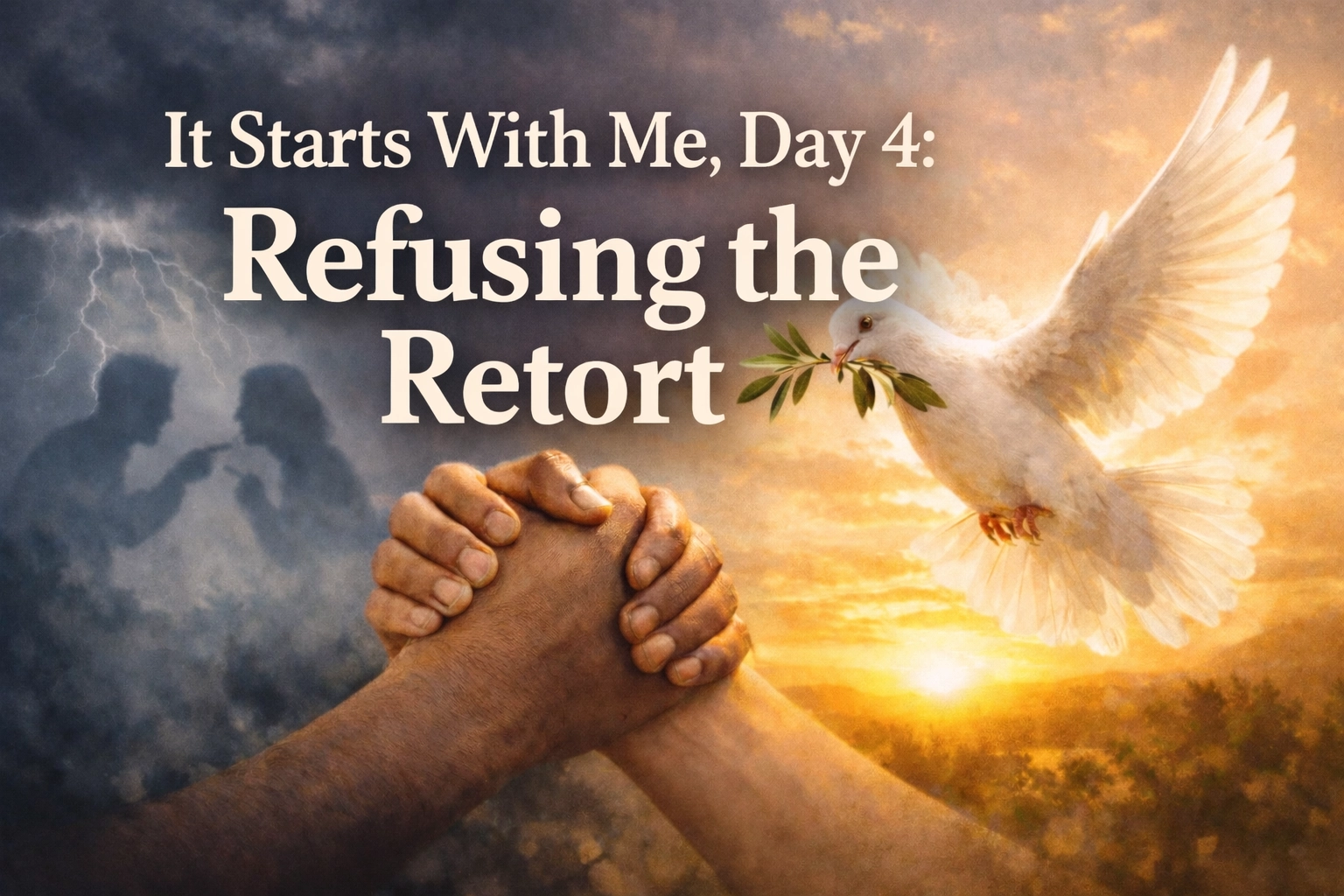
Day 4 is not a general meditation on quiet. It is the specific discipline of refusing negative engagement in arguments, in-person and online. Refusing the retort means refusing the familiar mechanics of contempt: the cutting reply, the sarcastic dunk, the moralized insult, the screenshot as weapon, the subtle cruelty disguised as clarity. This refusal is not the evacuation of truth. It is the submission of truth to love, and the submission of love to the Lordship of Jesus Christ. The disciple of Jesus does not outsource their tongue to fear or their attention to outrage. The disciple submits both speech and listening to the reign of God, because the crucified and risen Christ has already exposed the myth that righteousness is achieved by winning the exchange.
The retort fails first as worship. It assumes that the kingdom advances by domination. It assumes that dignity is preserved by retaliation. It assumes that the other person’s wrongness authorizes my harshness. It treats the neighbor as a problem to be solved rather than a person to be honored. Scripture calls this what it is: folly and faithlessness. “Pride only breeds quarrels, but wisdom is with those who take advice.” (Proverbs 13:10, WEBUS). The retort is pride dressed as courage; it is contention disguised as conviction.
The Core: Shama as the Alternative to Verbal Violence
The foundational discipline beneath refusing the retort is not silence but hearing. The Hebrew Scriptures name this with shama (שָׁמַע): to hear, to heed, to obey. The Shema is not a slogan but a yoke: “Hear, Israel: Yahweh is our God. Yahweh is one.” (Deuteronomy 6:4, WEBUS). Hearing is covenant posture. To hear is to come under authority. To refuse the retort is to come under authority in conflict, because the retort is what the autonomous self does when it will not shama—when it will not heed the Lord’s command to love the neighbor, to bless instead of curse, to refuse to repay evil for evil.
When the disciple will not hear, the disciple cannot obey. This is why James ties conflict ethics to auditory discipline: “So, then, my beloved brothers, let every man be swift to hear, slow to speak, and slow to anger.” (James 1:19, WEBUS). Swift to hear is not social technique; it is spiritual alignment. It is shama translated into the New Testament’s moral order: hearing first, then speaking; obedience first, then response. The retort reverses that order. It speaks first, then hardens; it reacts first, then rationalizes. It is not merely a personality problem; it is a deep-seated habit. It forms the worshiper into someone who cannot listen, cannot bear being challenged, cannot dignify another image-bearer with patient attention.
In covenant terms, refusing the retort is obedience to the God who hears. “For the eyes of the Lord are on the righteous, and his ears open to their prayer; but the face of the Lord is against those who do evil.” (1 Peter 3:12, WEBUS). Because the Father hears, the disciple does not need to force hearing through volume, humiliation, or pressure. The retort is what we do when we believe God is inattentive and must be replaced by our own immediacy.
The Posture: Prautēs as Strength Under Command
The New Testament does not frame meekness as weakness. It frames meekness as power governed by the will of God. The word is prautēs (πρᾳΰτης): meekness, gentle strength, strength under restraint. Paul commands it as a way of dealing with actual opposition: “The Lord’s servant must not quarrel, but be gentle towards all, able to teach, patient, in gentleness correcting those who oppose him.” (2 Timothy 2:24–25, WEBUS). The contrast is direct: not striving, but gentleness; not verbal combat, but meek instruction. The retort is “striving” baptized as righteousness. Prautēs is righteousness refusing to become cruelty.
James treats prautēs as the posture by which the word of God is received and then embodied: “Wherefore putting away all filthiness and overflowing of wickedness, receive with meekness the implanted word, which is able to save your souls.” (James 1:21, ASV). A retorting spirit cannot receive the implanted word because it is already full of itself. The retort is not only what we say to others; it is what we become: reactive, brittle, ready to wound. Prautēs is the opposite formation: a steadied soul, able to listen, able to answer without fire, able to leave space for repentance rather than engineering humiliation.
This is why refusing the retort is a failure of faith when it is absent. Faith trusts that God governs outcomes, that truth does not require cruelty to be true, that the Spirit can convict without my aggression. “for the anger of man doesn’t produce the righteousness of God.” (James 1:20, WEBUS). The retort often claims to be righteous anger; Scripture denies that claim at the root. Human wrath does not manufacture God’s righteousness. It manufactures more human wrath.
Conflict Reframed: From Battle of Wits to Dignity and Active Listening
The retort frames conflict as a battle of wits where the goal is victory, not reconciliation; exposure, not restoration; dominance, not dignity. That framing is worldly, and it inevitably produces enemies. It trains the heart to hunt for weaknesses, to reduce a person to their worst sentence, to treat an opponent’s embarrassment as moral good. The retort does not only answer; it accuses. It does not only clarify; it condemns. It does not only respond; it retaliates.
Refusing the retort reframes conflict as a place to preserve the imago Dei. The other person is not a monster to be unmasked. The other person is a creature made in the image of God, and therefore a being whose dignity is not cancelled by wrongness. This is the moral gravity behind Christ’s command: “But I tell you, love your enemies, bless those who curse you, do good to those who hate you, and pray for those who mistreat you and persecute you.” (Matthew 5:44, WEBUS). Enemy-love does not begin after agreement; it begins under provocation, when the flesh wants to punish. The retort is a way of making enemies out of neighbors by treating them as less than human. Refusing the retort refuses that transformation. It refuses to let disagreement become dehumanization.
Active listening, in this frame, is not a therapeutic add-on. It is obedience. It is shama applied in conflict: hearing in order to understand, hearing in order to respond without contempt, hearing in order to obey the command to honor all men. It is also evangelistic, because it witnesses to a different kingdom. “If it is possible, as much as it is up to you, be at peace with all men.” (Romans 12:18, WEBUS). Peace here is not mere quiet; it is the refusal to escalate, the refusal to weaponize the tongue, the refusal to treat the other as a target.
Speech Restrained: Siōpaō and Damam as Tactical Obedience, Not General Quiet
Refusing the retort still requires restraint, but restraint here is targeted: it is the refusal to answer contempt with contempt. Scripture provides language for this restraint without making the discipline identical to general stillness. The Greek verb siōpaō (σιωπάω) names the decision to keep silent at the moment when speech would become self-vindication or retaliation. “But Jesus held his peace.” (Matthew 26:63, KJV). In that courtroom, Christ refused the argument-as-salvation story. He did not entrust his innocence to rhetorical conquest. He entrusted himself to the Father.
The Hebrew verb damam (דָּמַם) names the quieting of the inner man so the mouth does not become a weapon. This is not the aesthetics of calm; it is the suppression of the ego’s demand to dominate. “My soul, wait in silence for God alone, for my hope comes from him.” (Psalm 62:5, WEBUS). The soul that is not quieted will retort as worship. The soul that is quieted can refuse negative engagement because it no longer needs the other person to certify its worth.
The Retort and the Making of Enemies
The retort turns neighbors into enemies by making the relationship adversarial by default. It assumes the other is acting in bad faith. It selects the harshest interpretation. It speaks as if the goal is to defeat rather than to understand. This is how contempt grows. “A gentle answer turns away wrath, but a harsh word stirs up anger.” (Proverbs 15:1, WEBUS). Grievous words do not end conflict; they recruit conflict. They stir. They summon. They multiply. The retort is fuel offered to wrath, and wrath is a cruel master.
Refusing the retort interrupts that multiplication. It preserves the other’s humanity by refusing to treat them as a mere obstacle to my public righteousness. It also preserves the disciple’s own humanity, because contempt deforms the one who speaks it. “Like a city that is broken down and without walls is a man whose spirit is without restraint.” (Proverbs 25:28, WEBUS). Lack of rule is not loudness only; it is the inability to remain gentle when provoked. Prautēs is the wall. Shama is the gate. The retort is the breach.
Refusing the retort is therefore a confession: God is Judge, so I will not act as judge with my tongue. God hears, so I will hear. Christ is meek, so I will take his yoke. The disciple does not abandon truth; the disciple abandons contempt. The disciple does not flee conflict; the disciple enters conflict under the rule of love, guarding the imago Dei in the other, because Christ guarded the image-bearer even while being murdered by image-bearers.
When the disciple refuses negative engagement, the disciple offers a sign that another kingdom is present. It is not the kingdom of instant vindication. It is not the kingdom of public shaming. It is the kingdom where the strong are gentle, where the wise are slow, where the faithful hear and obey, where enemies are not necessary for identity, and where speech exists to bless rather than to scorch.
Christ: The Silence of the King Under Accusation
The Scriptures do not leave restraint as abstract virtue. They place it on the Messiah’s lips by placing restraint on the Messiah’s lips. Isaiah’s Servant does not lack arguments; he refuses the game of self-vindication. “He was oppressed, yet when he was afflicted he didn’t open his mouth. As a lamb that is led to the slaughter, and as a sheep that before its shearers is mute, so he didn’t open his mouth.” (Isaiah 53:7, WEBUS). The Servant’s “dumbness” is not deficiency but submission—silence as obedience to the Father’s will, silence as non-retaliation in the face of injustice, silence as a refusal to answer violence with violence.
The Gospels present the fulfillment in concrete scenes. “But Jesus held his peace.” (Matthew 26:63, KJV). That sentence is not narrative filler; it is the revelation of the kingdom. The Greek verb is siōpaō (σιωπάω): to keep silent, to say nothing, to refrain from speech. Jesus is not cornered; he is reigning. His restraint is authority. He refuses to participate in the theater of accusation where victory is measured by domination. He does not treat the courtroom as a stage for personal vindication because he entrusts himself to the Father.
This is why Peter reads the Passion as instruction, not merely atonement. “When he was cursed, he didn’t curse back. When he suffered, he didn’t threaten, but committed himself to him who judges righteously.” (1 Peter 2:23, WEBUS). The moral logic is explicit: refusal of verbal retaliation is a form of entrusting. The verb choice matters: Christ committed himself to the righteous Judge. That is what the retort refuses to do. The retort is the insistence that I must manage the verdict. Christ-like restraint is the surrender of the verdict to God.
The Discipline: Verbal Disarmament as Kingdom Witness
Refusing the retort is not an inner mood; it is a public witness. It is a declaration that the kingdom of God does not advance by humiliation and dominance, that righteousness is not secured through rhetorical conquest, that peace is not produced by louder fire. Silence becomes confession: Christ is Lord; therefore my mouth is not autonomous.
The Hebrew damam (דָּמַם) and the Greek siōpaō (σιωπάω) meet here as one discipline with two horizons. Damam is the quieting of the soul under God’s providence; siōpaō is the restraint of the mouth under pressure. Together they form an embodied theology: the disciple refuses the retort because the disciple has been quieted by God. If the heart is not quieted, the mouth will not be restrained. If the mouth is not restrained, the heart will be further inflamed. The discipline cuts the feedback loop of outrage by severing speech from the ego’s need to rule.
This discipline is not silence-as-cowardice. Scripture knows that there is a time to speak. Jesus speaks when speech is obedience; he is silent when silence is obedience. The question is not whether the disciple ever speaks; the question is whether the disciple’s speech is crucified. “Let every man be swift to hear, slow to speak, slow to wrath.” (James 1:19, KJV). Slowness is not indecision; it is dominion. It is the Spirit-governed refusal to hand the tongue to wrath.
Verbal disarmament is neighbor-love because it refuses to use words as punishment. It is enemy-love because it refuses to dehumanize the accuser. It is forgiveness because it refuses to collect emotional debts through public shaming. It is peace because it will not contribute fuel to the furnace. It is not softness toward evil; it is hardness toward the self’s hunger to retaliate.
The kingdom is witnessed in restraint. In a culture trained to confuse immediate reaction with strength, the disciple’s silence is a rebuke to the false gods of urgency and image. It declares that truth is not fragile, that God does not need my panic, that my neighbor is not my opponent, and that my mouth belongs to another King.
If you want to keep walking with Antiha in this practice—toward a life that rejects outrage culture and chooses disarmament—our resources are free at:
antiha.org/it_starts_with_me.html
Antiha: Not Left. Not Right. Anti-Hate. It Starts With Me.