By Chris Richards
Founder, Antiha.org
Published March 8, 2026
I’m not proud of this, but I’ve definitely had moments where I set my phone down and thought, "Wow… I’m mad and I don’t even know that person." Have you ever had that sudden, hot spike in your chest while scrolling? You know the one. It’s that "I can’t believe they just said that" feeling. Your thumbs hover over the keyboard, ready to fire off a response that will finally—finally—put them in their place.
Welcome to the Outrage Trap.
It’s a place most of us visit way too often, usually without even realizing we’ve crossed the border. We live in a culture that treats outrage like a commodity—bought, sold, and traded for clicks, likes, and "engagement." But if you’re trying to follow the way of Jesus, this isn’t just a social media annoyance. It’s a heart problem. And it can quietly pull us away from the peace we say we want.
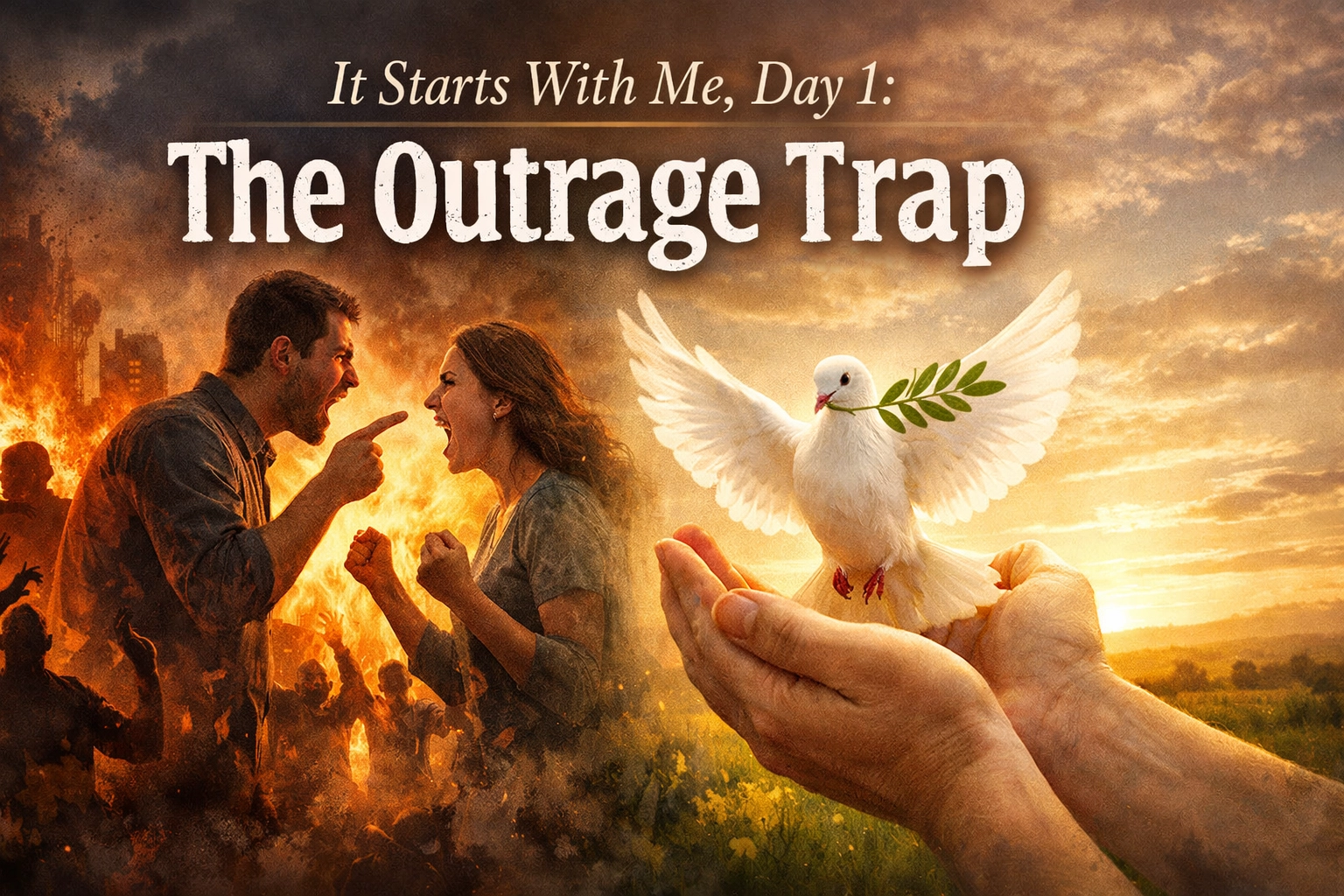
This post is Day 1 of It Starts With Me: a 7-day series on Antiha's method of responding to modern outrage culture. Over the next seven days, we’re going to get super practical about how we (as a community at Antiha) can stop reacting to the world’s noise and start responding with the heart of a peacemaker. It starts by getting honest about why outrage hooks us—and the quiet, internal choice that can break the cycle.
The Anatomy of the Hook
Why is it so easy to get angry so fast—especially online? Uh-hum, literally, our brains are wired for threat-detection. When we see something that feels dangerous to our identity, our values, or our "tribe," the amygdala lights up and our body prepares for fight or flight. In the digital age, "fight" often looks like a 200-word comment typed in all caps… with receipts.
Fun Fact: Outrage spreads fast because it’s energizing. A lot of research around "moral outrage" shows it can create a rewarding feedback loop—your brain gets a little hit of satisfaction for spotting wrong and signaling right. Translation: being outraged can feel like clarity, purpose, and belonging all at once.
But here’s the catch: that feeling is addictive, and like any addiction, it costs us. It can shrink our empathy, speed up our assumptions, and turn real people into cardboard cutouts. We think we’re defending truth, but often we’re just feeding the machine—and draining our own peace. Peacemaking isn’t about winning an argument; it’s about winning a brother or sister.
The "Skandalon": The Stumbling Block (AKA the Trigger in the Trap)
Have you ever noticed how outrage doesn’t just happen to you—it almost feels like something sets you off? The New Testament has a word for that: skandalon (σκάνδαλον).
Originally, a skandalon wasn’t just a vague "stumbling block." It was the trigger-stick in a trap—the mechanism that held the bait. Touch the bait, the skandalon shifts, and the trap snaps shut.
That’s a surprisingly helpful picture for modern outrage. The post, the comment, the headline—that’s the bait. The surge in your chest—that’s the moment the skandalon gets bumped. And here’s the hard truth: the trap doesn’t fully close when someone else posts something terrible. It closes when I take the offense—when I let it hook my heart and hijack my response.
Jesus warns about skandala because they trip us into losing love. Not just love for "them"—love in us. (See Matthew 18:6–9 for how seriously Jesus talks about stumbling blocks.)
Jesus was a master at avoiding the skandalon. Think about the times people tried to trap Him. They brought Him a woman caught in adultery, hoping He’d either break the Law of Moses or lose His reputation for mercy. They asked Him about paying taxes to Caesar, trying to force Him into a political corner.
In every instance, Jesus didn’t take the bait. He didn't get "outraged" in the way they expected. He paused. He stooped to draw in the dirt. He asked a question back. He broke the cycle by refusing to play the game on their terms.
The Choice to Break the Cycle
What if the most powerful thing you can do today isn’t to post the perfect comeback—but to stay free? Peacemaking starts within. It’s a bold claim, but it’s the heart of everything we do at Antiha. If we haven't found peace in our own hearts, we will never be able to manufacture it in our communities.
The "Outrage Trap" relies on speed. It wants you to move from Perception (I saw this) to Reaction (I am angry / I will attack) in a split second.
To break the cycle, we insert a third step: Reflection.
The Internal Pause
Before you type. Before you vent. Before you judge. Ask yourself:
1.. Where did the hook catch? Is this about protecting someone vulnerable—or protecting my ego?
2. What am I actually craving right now? Justice, control, belonging, a dopamine hit, the last word?
3. What would love do first? Not "What would a winner do?" but what would the way of Jesus do first?
4. What is one peaceful next step? (Mute. Walk away. Pray. Ask a clarifying question. Talk to a real human offline.)
This is how we step around the skandalon instead of stepping on it.
Tuning the Heart
Have you ever felt "out of tune" after a long scroll session—like you didn’t even do anything, but you’re tense, cynical, and ready to bite someone’s head off? Sometimes, finding peace in a loud world is like learning to play a complex piece of music. It takes patience, practice, and the right "tuning."
If you’ve ever tried to play an instrument that was out of tune, you know that no matter how hard you push, the sound is just... off.
Our hearts are the same way. When we’re tuned to outrage, our lives produce discord. When we’re tuned to Jesus—
Radical Love, Radical Peace, and
Radical Forgiveness—we start to produce something different. And one of the most natural outcomes of that kind of life is radical compassion (not as a separate "pillar," but as the fruit that grows when love/peace/forgiveness go from ideas to a lifestyle).
if you’re new to Antiha, you can learn more about what we’re doing at antiha.org.
Radical Love vs. Radical Outrage
Jesus didn't call us to be "nice" or "passive." He called us to be peacemakers. There is a massive difference. A "nice" person ignores the problem. A peacemaker enters the conflict but brings a different spirit.
Radical love is the only thing strong enough to dismantle the outrage trap. It’s the choice to see the person on the other side of the screen not as an "enemy" or a "troll," but as someone made in the image of God: someone who is likely just as trapped in their own cycle of fear and outrage as anyone else.
The "It Starts With Me" Challenge for Day 1:
Today, I want to invite you to do something radical. The next time you feel that "hook": that skandalon: don't react. Just sit with it. Acknowledge the anger, but don't let it drive the car.
Instead of reacting externally, do the work internally. Pray for the person who posted the thing that upset you. Not a "Lord, show them how wrong they are" prayer, but a genuine "Lord, bless them and heal whatever is hurting in them" prayer. It sounds impossible, right? That’s because it is... without the help of the Spirit.
Why This Matters for Social Impact
At Antiha, we believe that social impact isn't just about big programs or policy changes. It’s about the transformation of the human heart. If we want a world with less hate, we have to be people who have less hate in us.
We can’t build a bridge while we’re busy throwing stones.
The Outrage Trap is designed to keep us divided. It keeps us focused on the "them" and the "those people." But the message of the Cross is that there is no "them." There is only "us": a broken humanity in need of a Savior who refused to stay in the boxes we built for Him.
Moving Forward
As we go through this 7-day series, we’re going to dig deeper into how we communicate, how we forgive, and how we practically live out "Anti-Hate" in a world that seems to thrive on it.
But for today, just focus on the hook. Notice when you’re being baited. Notice the physical sensation of outrage. And in that moment, make the choice to breathe and step back.
Remember, peacemaking isn't something we do after the war is over; it's the way we prevent the war from starting in our own souls.
It’s not easy. In fact, it’s one of the hardest things you’ll ever do. But it’s the only way to find true freedom.
Stay tuned for Day 2, where we’ll talk about the power of the "Second Look" and how to see people through the eyes of grace.
It Starts With Me.
Antiha
Not Left. Not Right. Anti-Hate.